
Disclosure: As an Amazon Associate, Housenique earns from qualifying purchases. Some links in this article are affiliate links — we may earn a small commission at no extra cost to you. All recommendations are based on our own research and editorial judgment.
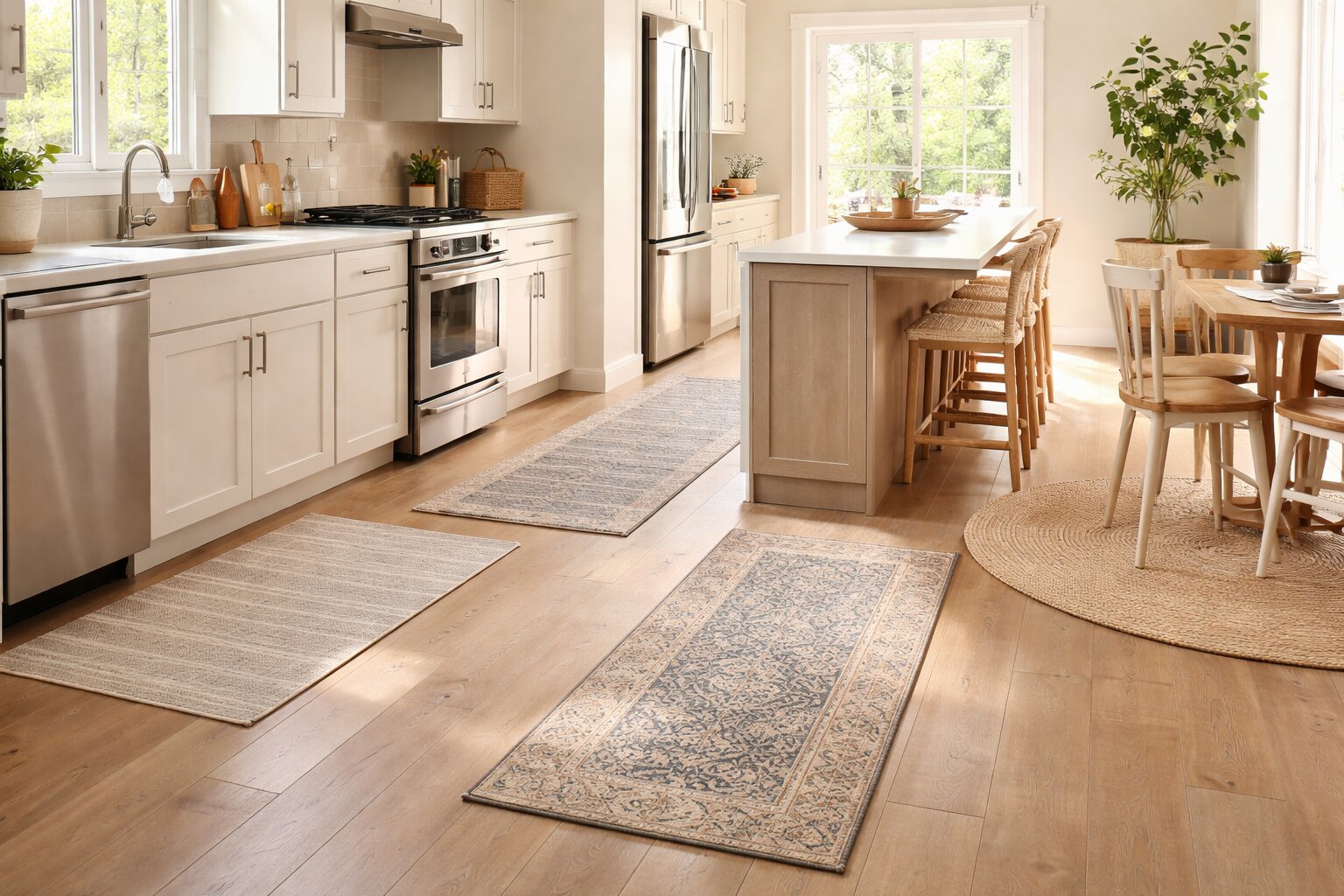
Choosing a kitchen rug sounds simple — until you’re standing in your kitchen holding a tape measure, second-guessing every decision. Do I need a runner or an area rug? What material won’t fall apart after the first wash? Will this color hide the inevitable coffee spills?
We’ve helped thousands of Housenique readers navigate exactly these questions. In this complete buying guide, we walk you through every decision point — from measuring your space correctly to matching a rug style to your kitchen’s aesthetic — so you can buy with confidence and avoid the most common (and expensive) mistakes.
💡 Already know what you want? Jump straight to our [Best Kitchen Rugs 2026: Our Top Picks] for our curated shortlist across every category.
Why Getting This Decision Right Actually Matters
We see a lot of readers treat the kitchen rug as an afterthought — something to grab quickly and sort out later. In our experience, that approach leads to rugs that slide, rugs that shed, rugs that look great in product photos but horrible on real kitchen floors, and rugs that fall apart after two washes.
A well-chosen kitchen rug, on the other hand, is something you’ll notice in the best possible way every single day — underfoot while you’re cooking, visually every time you walk in, and practically every time a spill happens and cleanup takes 30 seconds instead of 30 minutes.
Getting it right is worth the extra 10 minutes of research. That’s what this guide is for.
💡 Want the full picture? Our [Ultimate Guide to Kitchen Rugs for US Families] covers benefits, safety, design trends, and maintenance all in one place.
Step 1: Measure Your Space Before Anything Else
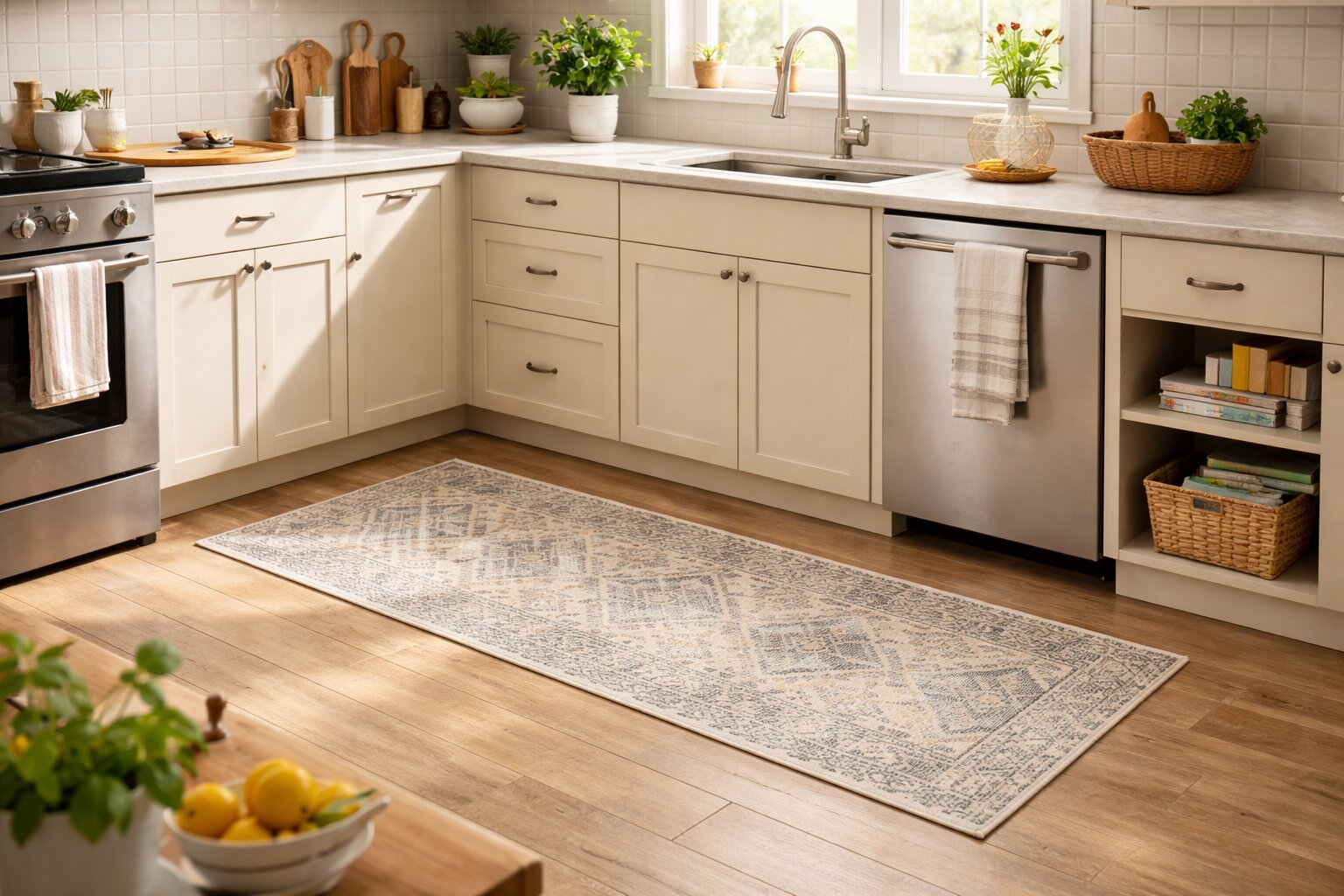
The single most common kitchen rug mistake we see: buying without measuring. A rug that looks perfectly proportioned on a product page can look laughably small — or frustratingly large — in your actual kitchen. Don’t skip this step.
How to Measure for a Kitchen Rug
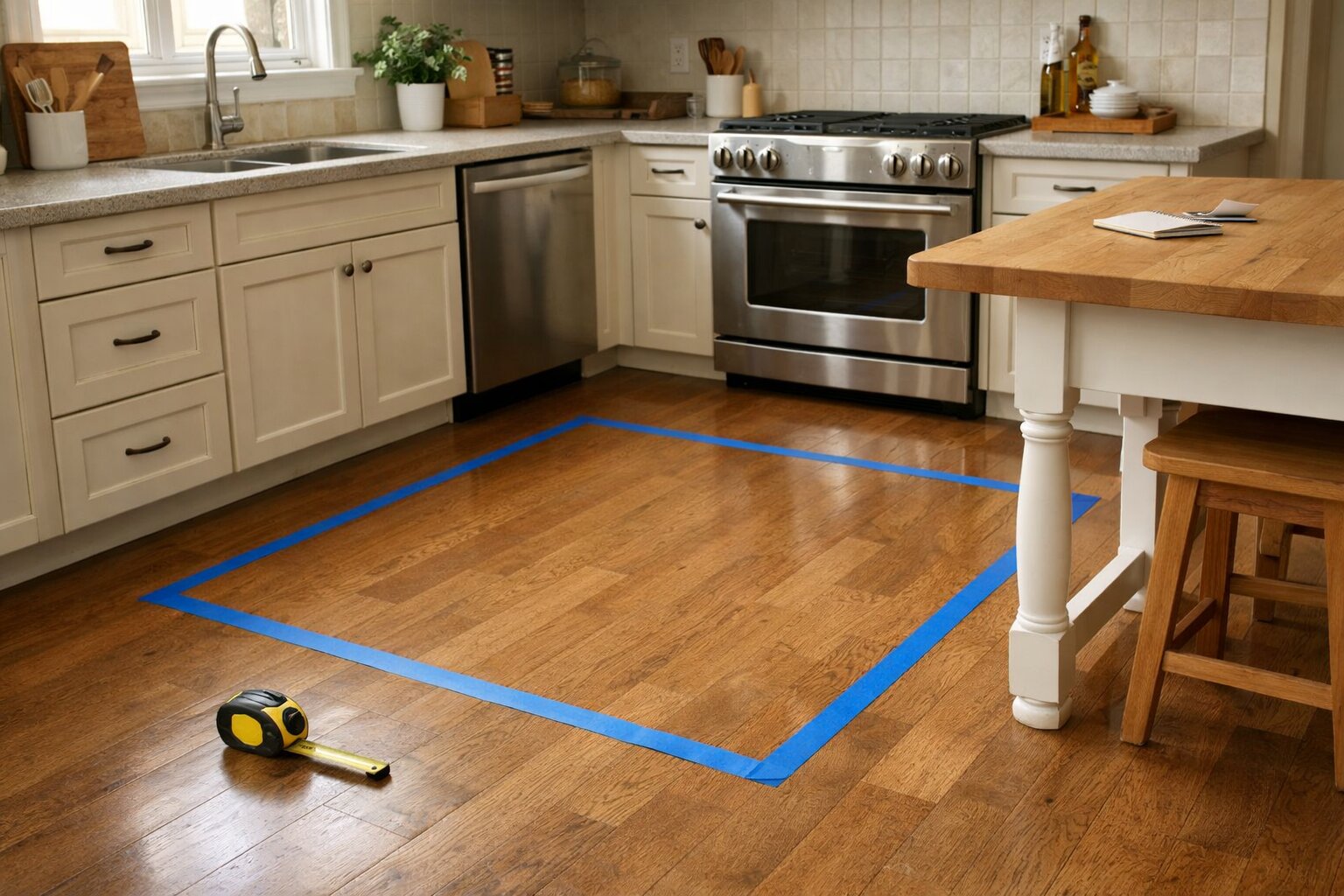
What you need: A tape measure, painter’s tape, and 5 minutes.
-
Measure the zone, not the room. Kitchen rugs aren’t meant to cover the whole floor — they anchor specific work zones (sink, stove, island, table). Measure the area where you’ll be standing most.
-
Mark it out with painter’s tape. Tape the outline of your intended rug size on the floor before ordering. This single step has saved our readers countless returns. What looks right on paper often looks wrong in person.
-
Leave clearance at the edges. We recommend at least 4–6 inches of bare floor between the rug edge and any cabinet base or island leg. This prevents the rug from catching on door swings and looks visually clean.
-
Account for traffic paths. If your rug will sit in a walkway, make sure neither end crosses a doorway threshold — a raised edge in a foot-traffic zone is a tripping hazard.
Kitchen Rug Size Guide by Zone
Kitchen Zone Recommended Rug Size
In front of the sink 18″–24″ deep × 24″–36″ wide In front of the stove 18″–24″ deep × 24″–30″ wide
Galley kitchen (full run) 2’×6′, 2’×8′, or 2’×10′ runner Kitchen island (one side) 2’×6′ or 2’×8′ runner
Kitchen table / breakfast nook 4’×6′ area rug or 3′ round rug Small apartment kitchen 2’×3′, 2’×4′, or 2.5’–3′ round
🔗 Read more: [Kitchen Rug Size & Placement Guide] — our dedicated guide with sizing charts for every kitchen layout type, including L-shaped, open-plan, and galley kitchens.
Step 2: Choose the Right Material for Your Kitchen’s Reality
Material is where most buying guides get vague. We’re going to be direct: the “best” material depends entirely on how you actually use your kitchen. Here’s our honest breakdown of every major option.
Cotton — Our Top Pick for Most Family Kitchens
Cotton is the material we recommend most often at Housenique, and for good reason: it’s soft, it washes beautifully, and it’s genuinely affordable enough to replace when it wears out.
What we love about cotton:
-
Fully machine-washable in most standard home washers — cold, gentle cycle
-
Soft underfoot, which matters when you’re standing barefoot first thing in the morning
-
Wide range of patterns, colors, and weave styles — flatweave, loop, and tufted all available
-
Budget-friendly enough that replacing every 1–2 years isn’t a financial burden
Where cotton falls short:
-
Less durable than synthetic options under very heavy foot traffic
-
Can compress and flatten over time, especially in thick pile versions
-
Some dyes bleed on the first wash — always wash separately the first time
Best for: Everyday family kitchens, anyone who prioritizes easy cleaning, households with young children or pets.
👉 [Shop cotton kitchen rugs on Amazon]
Affiliate disclosure: As an Amazon Associate, I earn from qualifying purchases. This helps support my content at no extra cost to you.
Polypropylene (Synthetic) — The Workhorse Material
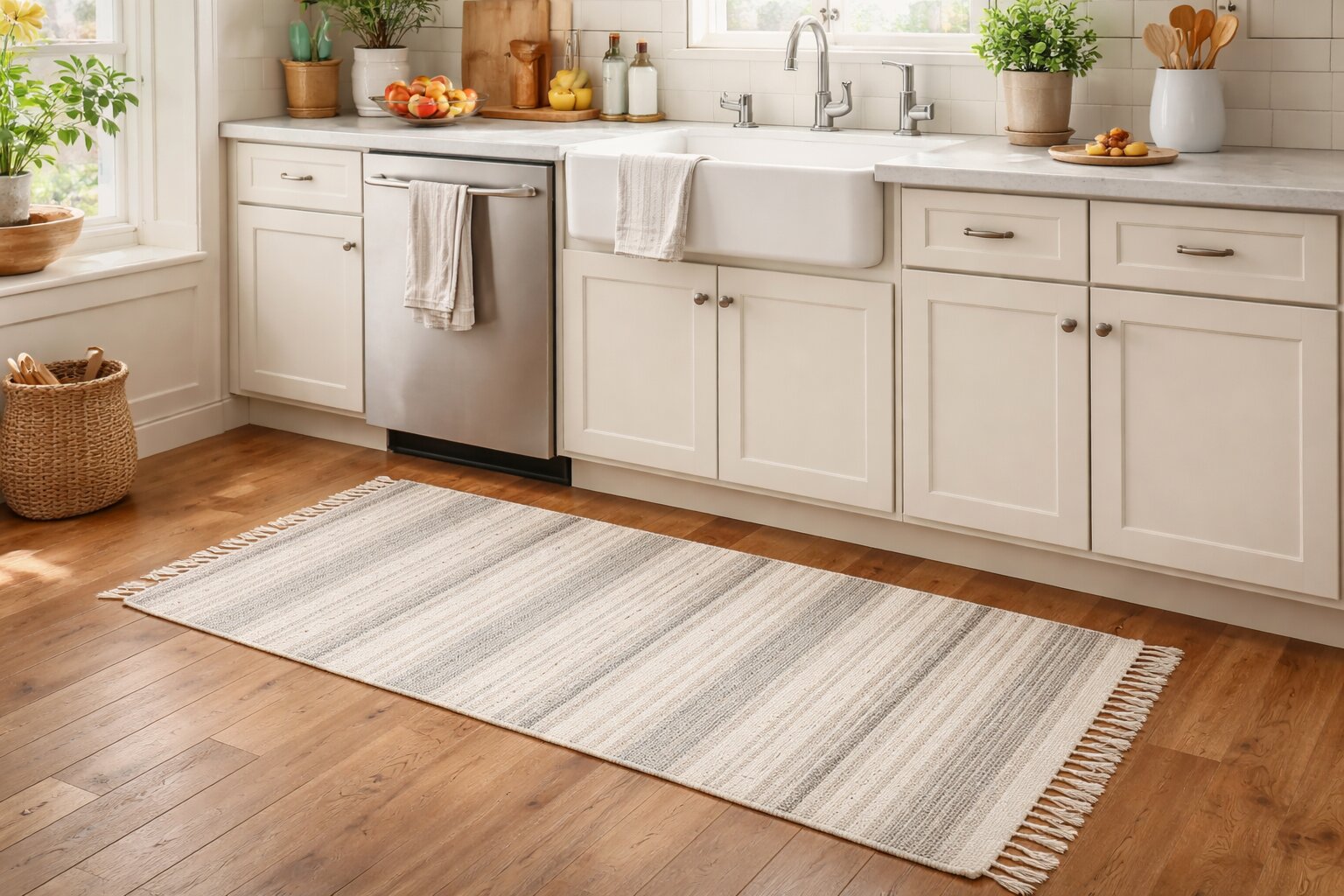
If your kitchen sees serious traffic, serious spills, or both — polypropylene is the material to consider. It’s what we’d put in a kitchen with three kids and a large dog.
What we love about polypropylene:
-
Inherently stain-resistant — liquids bead on the surface rather than soaking in immediately
-
Holds up under heavy foot traffic far better than cotton or natural fibers
-
Solution-dyed fibers don’t fade after repeated washing — colors stay vibrant
-
Moisture and mildew resistant — ideal for the zone directly in front of the sink or dishwasher
-
Many options are fully machine-washable
Where polypropylene falls short:
-
Less soft underfoot than cotton or wool — not ideal if barefoot comfort is your priority
-
Can feel slightly plasticky — lower-quality versions especially
-
Some lighter-weight polypropylene rugs slide on hard floors even with rubber backing
Best for: High-traffic kitchens, households with heavy cooking routines, anyone with repeated spill issues.
👉 [Shop polypropylene kitchen rugs on Amazon]
Affiliate disclosure: As an Amazon Associate, I earn from qualifying purchases. This helps support my content at no extra cost to you.
🔗 Read more: [Kitchen Rug Materials: Cotton, Jute, Wool or Synthetic?] — our full material comparison with durability ratings, wash instructions, and real-use recommendations.
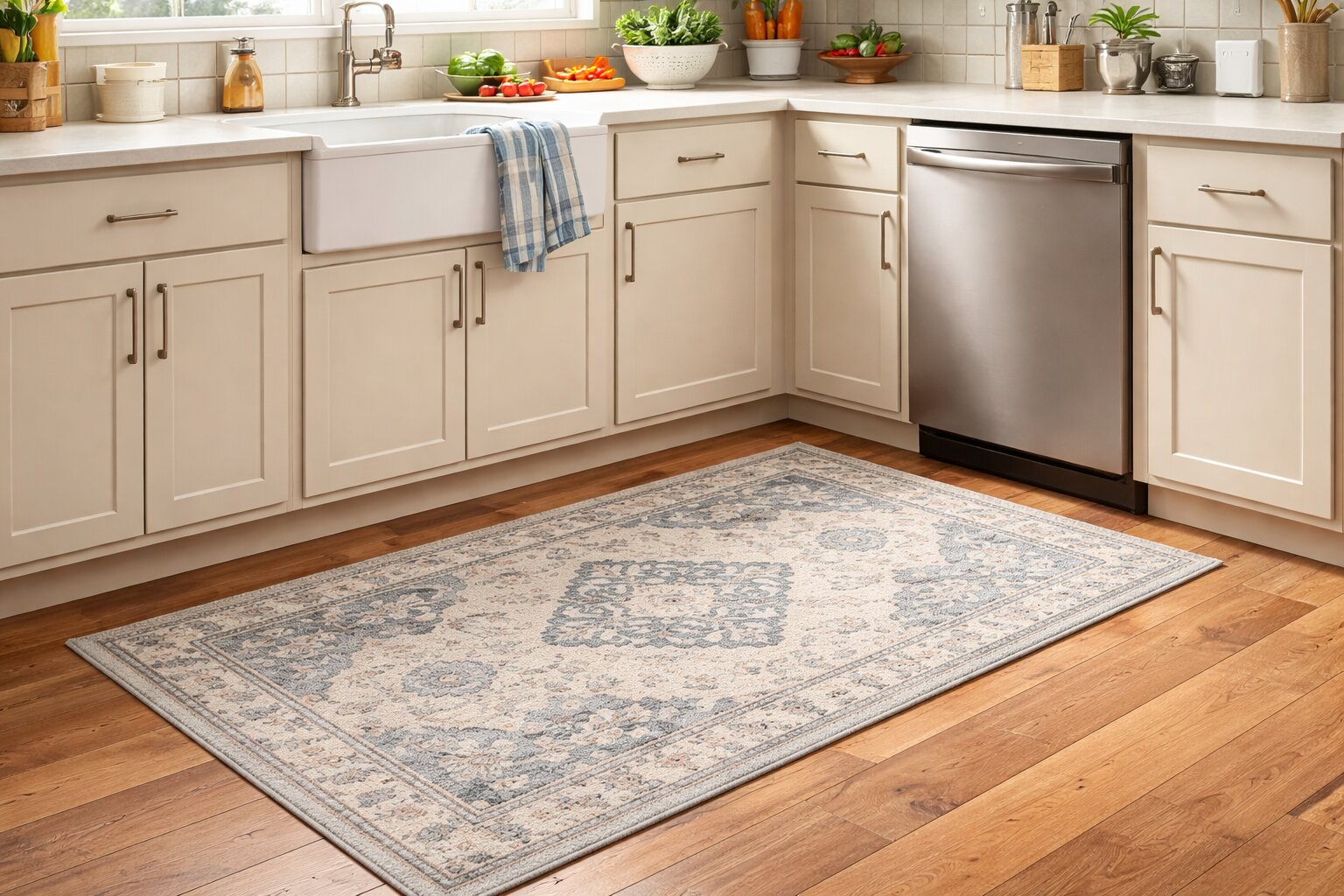
Jute and Seagrass — Beautiful, but Placement-Specific
We genuinely love the look of natural fiber rugs. There’s a warmth and texture to a jute flatweave that no synthetic can fully replicate. But we’d be doing our readers a disservice if we recommended them for every kitchen situation.
What we love about jute/seagrass:
-
Organic, textured aesthetic that adds warmth instantly
-
Naturally eco-friendly — renewable and biodegradable
-
Flatweave constructions are thin, easy to sweep, and lightweight
-
Beautiful as a statement piece in a dry kitchen zone
Where natural fibers fall short:
-
Not suited for areas near the sink or stove. Repeated moisture exposure causes mold, discoloration, and fiber breakdown. This is a hard limit, not a guideline.
-
Not machine-washable — spot clean only
-
Less grippy on hard floors — usually requires a separate rug pad
Best for: Dry kitchen zones only — under a breakfast table, near a pantry, or as a decorative accent away from water sources.
👉 [Shop jute kitchen rugs on Amazon]
Affiliate disclosure: As an Amazon Associate, I earn from qualifying purchases. This helps support my content at no extra cost to you.
🔗 Read more: [Organic & Natural Fiber Kitchen Rugs: Sustainable Choices] — placement tips and care advice for natural fiber rugs in kitchens.
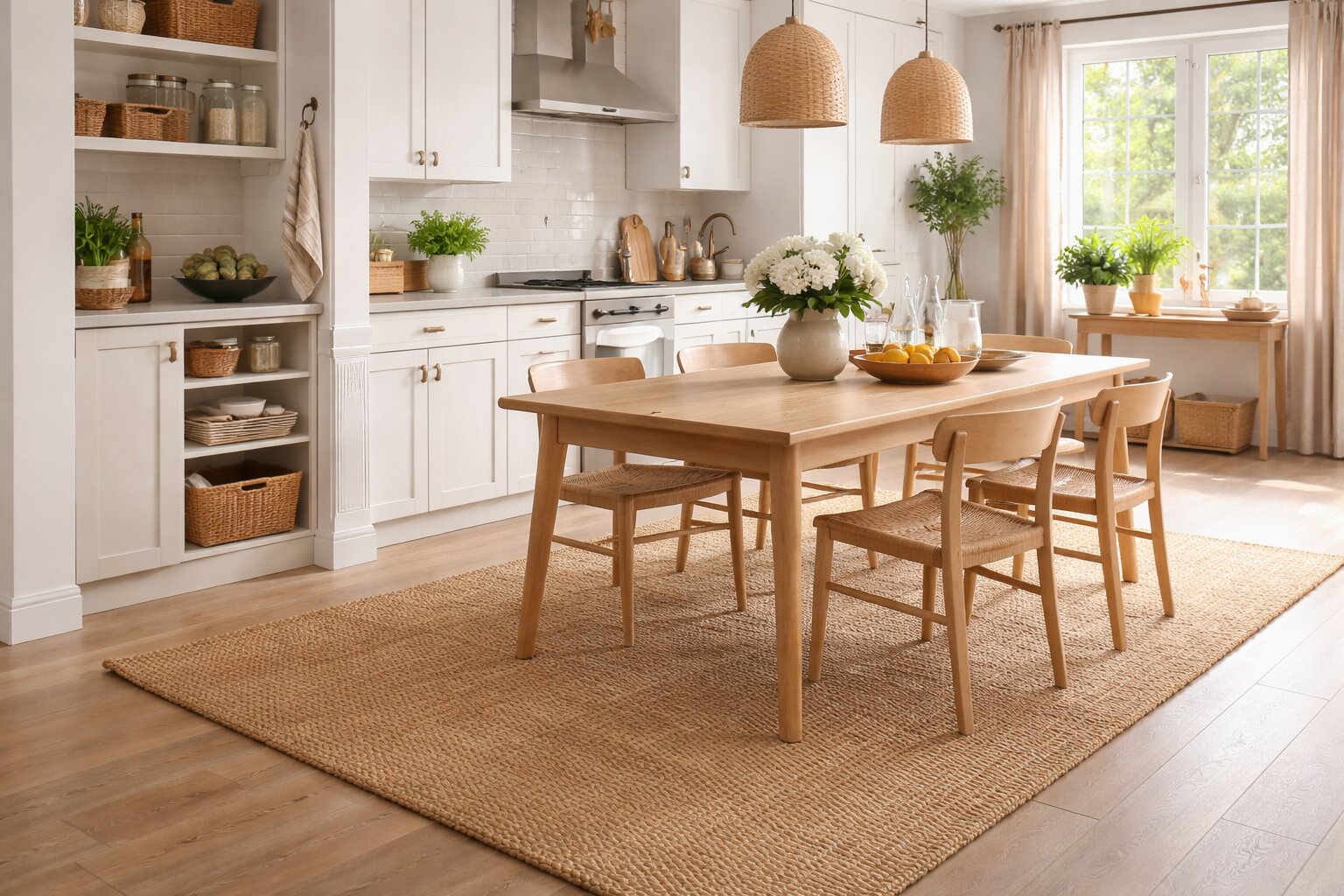
Wool — The Premium Long-Term Investment
Wool is what we recommend when a reader says: “I want something that looks beautiful and lasts a decade.” It’s a genuine long-term investment — but it comes with real limitations in a kitchen setting.
What we love about wool:
-
Dense pile that’s naturally resilient under foot traffic
-
Wool fibers naturally repel light liquid spills (within a quick response window)
-
Rich color depth and texture that mass-produced synthetics can’t match
-
Hand-tufted or hand-knotted versions develop a beautiful patina over time
Where wool falls short:
-
Most wool rugs are not machine-washable — professional cleaning or careful hand washing only
-
Significantly higher price point than cotton or synthetic options
-
Best placed away from high-splash zones — near the kitchen table or in an open-plan kitchen-living area
Best for: Style-focused homeowners, lower-splash zones, anyone who wants a rug that doubles as a design statement.
👉 [Shop wool kitchen rugs on Amazon]
Affiliate disclosure: As an Amazon Associate, I earn from qualifying purchases. This helps support my content at no extra cost to you.
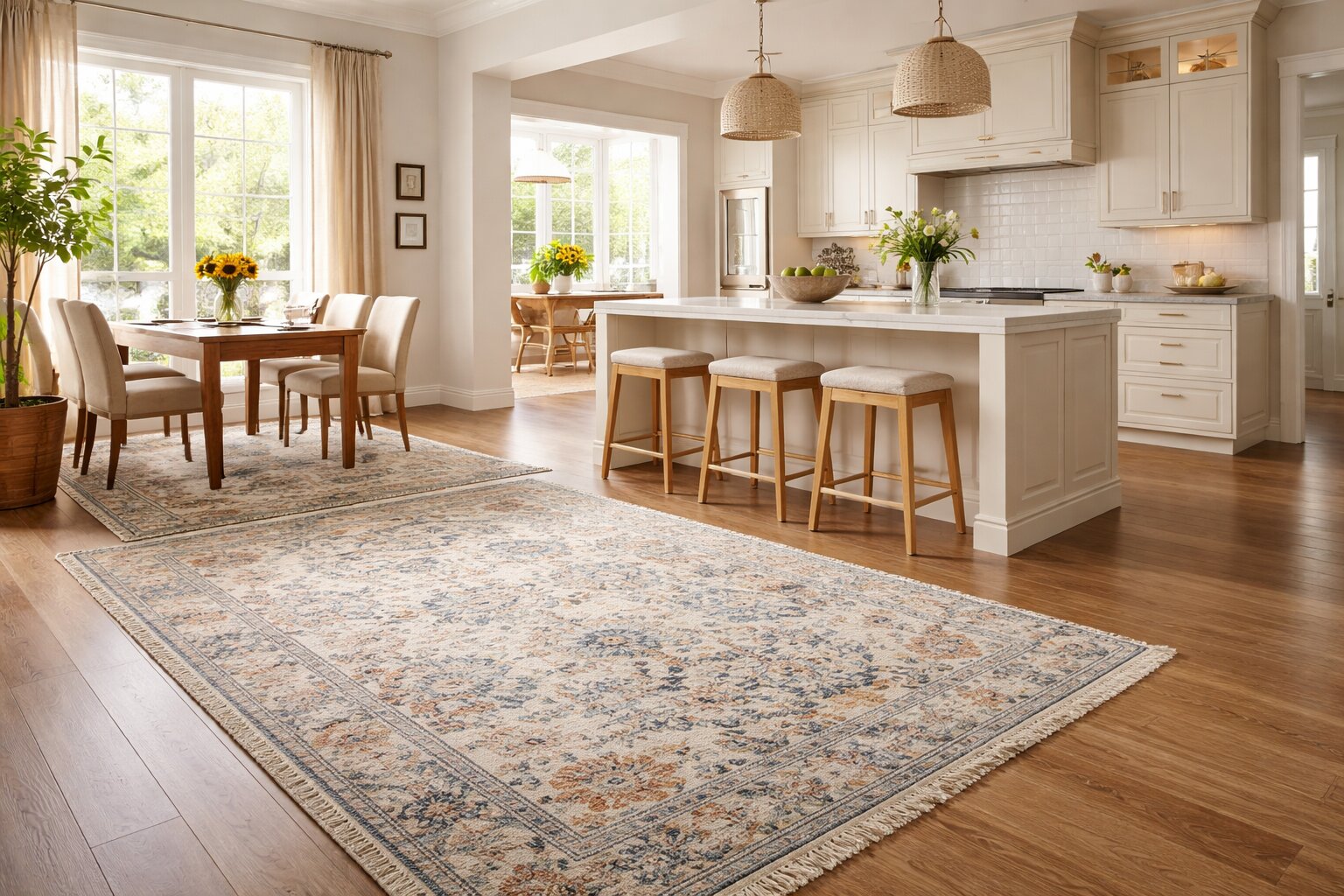
Recycled and Eco-Certified Synthetics — The Best of Both Worlds
This is a category we’re increasingly excited about recommending. Recycled synthetic rugs — made from materials like repurposed plastic bottles — combine the practical performance of polypropylene with genuine sustainability credentials.
Best for: Eco-conscious families who don’t want to compromise on washability or durability.
🔗 Read more: [Eco-Friendly & Washable Rugs for Busy Families] — our roundup of sustainable rug options that hold up in real family kitchens.
Step 3: Evaluate Slip Resistance
We cannot overstate this: a kitchen rug that slides is more dangerous than no rug at all. The floor near your sink is regularly damp. The path to the fridge gets traffic dozens of times a day. Slip resistance is non-negotiable, especially in homes with children, seniors, or pets.
Your Options for Non-Slip Performance
Option A — Built-in rubber or TPR backing: The most convenient choice. Look for thick, textured rubber (not thin spray-on coating, which peels and crumbles after washing). Quality rubber backing grips tile, hardwood, and laminate reliably. One caveat: thick rubber can trap moisture under sealed hardwood floors over time — lift and air periodically.
Option B — Separate rug pad: If you fall in love with a rug that doesn’t have built-in grip, a quality rug pad solves the problem. Dual-sided grip pads work on hard floors and add cushioning at the same time. This is also the safer option for hardwood floors where rubber-to-finish contact is a concern.
Option C — Rug tape: For very lightweight rugs or runners in low-traffic zones, double-sided carpet tape keeps edges flat and prevents shifting. Less convenient for frequently washed rugs, but effective for permanent placements.
What we look for on a product listing:
-
Mentions of “thick rubber backing,” “TPR backing,” or “non-skid backing”
-
Verification that the backing survives machine washing (some rubber backings degrade quickly in hot water cycles)
-
Low-pile or flatweave construction (fewer curling issues at edges)
👉 [Shop non-slip rug pads on Amazon]
Affiliate disclosure: As an Amazon Associate, I earn from qualifying purchases. This helps support my content at no extra cost to you.
🔗 Read more: [Non-Slip Kitchen Rugs: Safety for Kids and Pets] — our complete guide to grip options, rug pads, and what to check before buying.
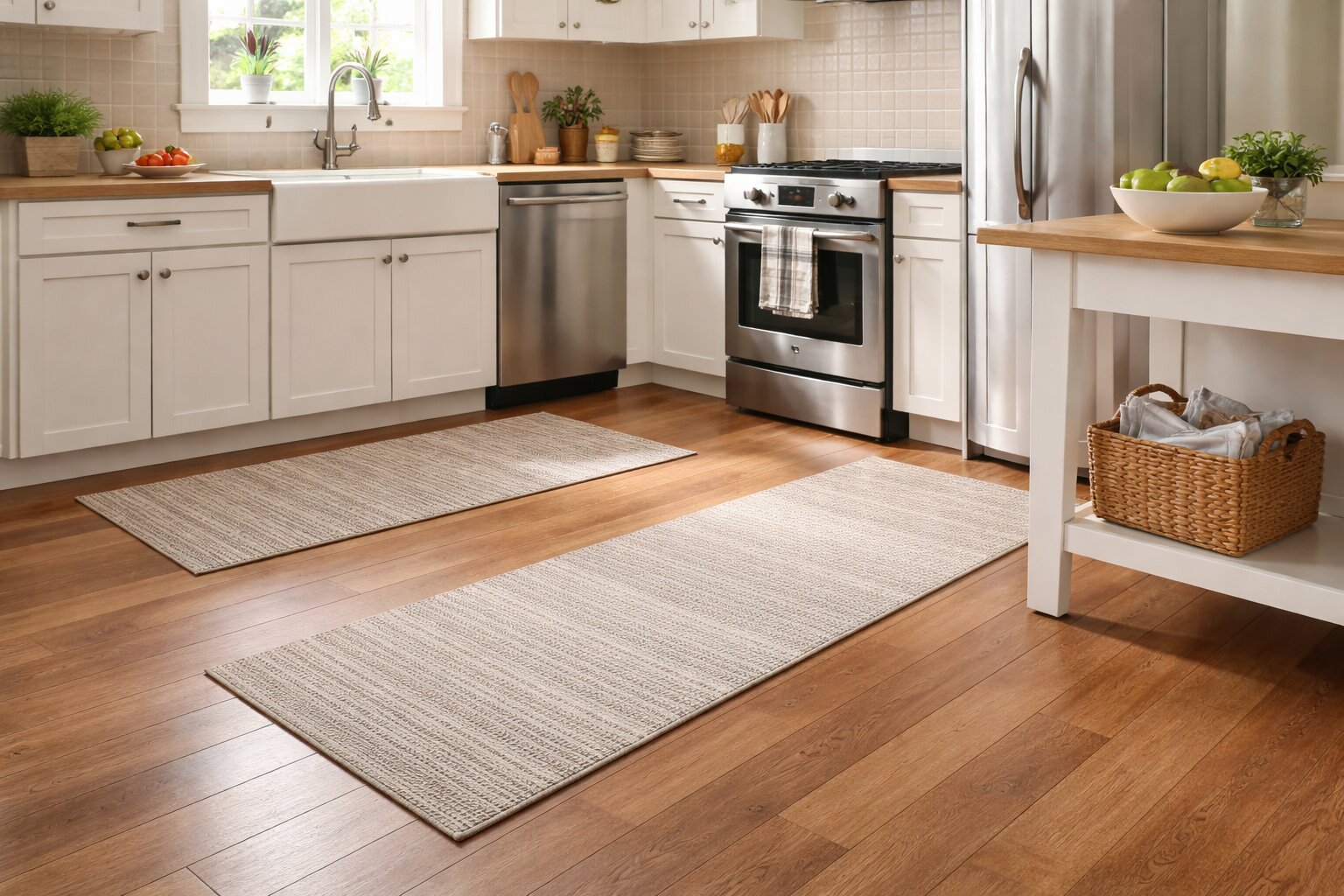
Step 4: Prioritize Washability for Kitchen Use
This step is short because the advice is simple: if it’s not machine-washable, think carefully before putting it in a kitchen.
Kitchens generate grease, sauce splatter, coffee drips, muddy footprints, and pet mess. A rug that can’t go in the washing machine will either look dirty most of the time or require frequent professional cleaning — neither is practical for a busy household.
Our washability checklist:
-
✅ Can it fit in your home washer? (Check dimensions — rugs over 3’×5′ may need a commercial machine)
-
✅ What temperature? (Cold only preserves rubber backing and prevents color bleeding)
-
✅ Tumble dry or air dry? (Air dry is gentler; low-heat tumble dry is more convenient — check the label)
-
✅ Will the backing survive repeated washing? (Ask about rubber backing durability in reviews)
-
✅ Are the dyes colorfast? (Check reviewer notes on color retention after 5–10 washes)
👉 [Shop machine-washable kitchen rugs on Amazon]
Affiliate disclosure: As an Amazon Associate, I earn from qualifying purchases. This helps support my content at no extra cost to you.
🔗 Read more: [Machine-Washable Kitchen Rugs: Pros, Cons & Top Brands] — everything you need to know about washability, care labels, and the best brands in this category.
Step 5: Choose a Style That Works With Your Kitchen
Once the functional boxes are checked, the fun part begins. Here’s how we approach kitchen rug styling recommendations for Housenique readers.
Match Pile Height to Your Kitchen Layout
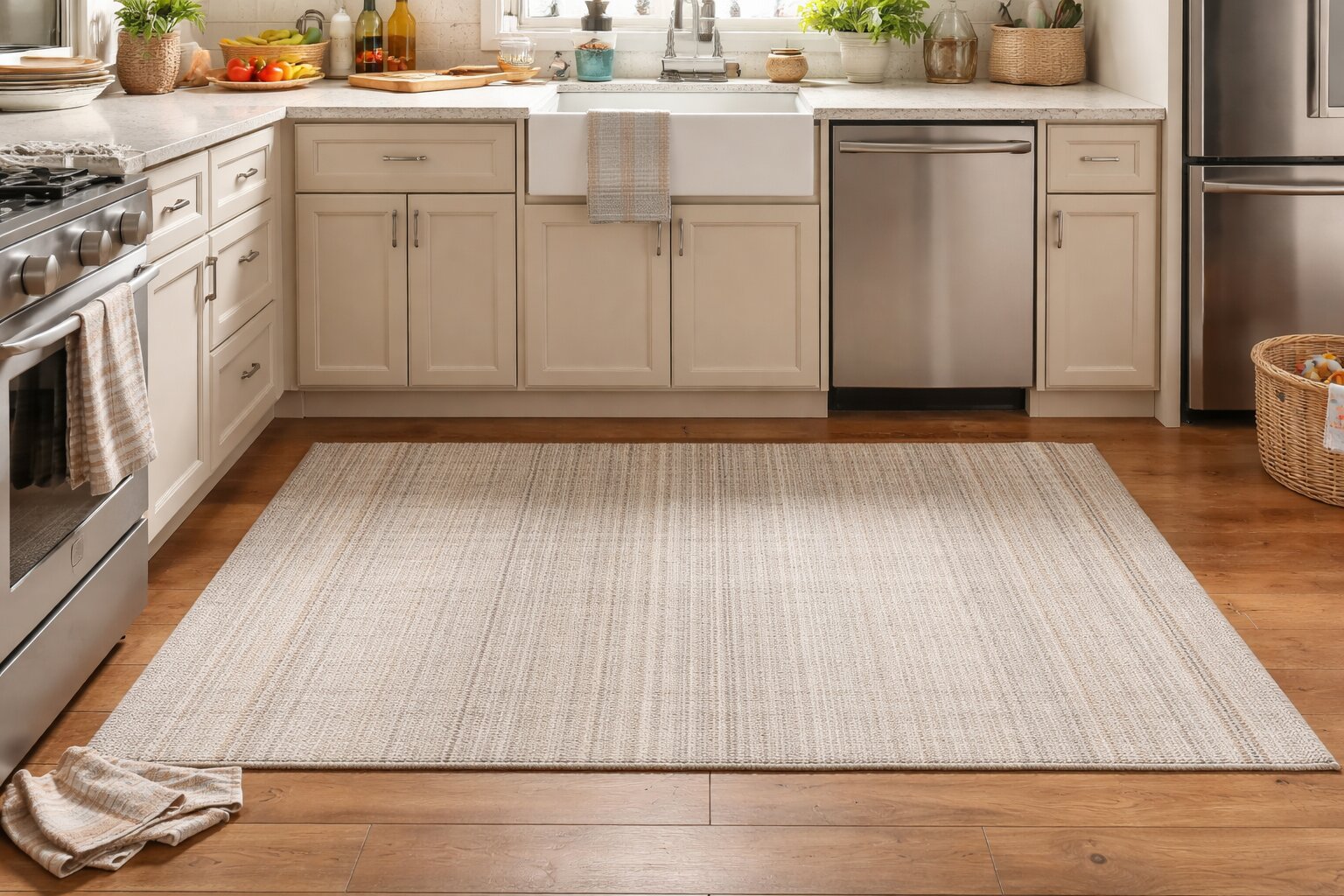
Low-pile and flatweave (under ½ inch): Our default recommendation for most kitchens. Flat rugs stay flush with the floor, don’t curl at edges, vacuum easily, and dry faster after washing. They work in virtually every kitchen style and are the safest choice for doorways and high-traffic paths.
Medium-pile (½ to ¾ inch): Adds a bit more cushioning and visual softness. Fine for zones away from high-traffic doorways. Works especially well near kitchen tables and breakfast nooks.
High-pile or shag (over ¾ inch): We generally don’t recommend these for kitchens. They trap crumbs, take longer to dry, can become tripping hazards at the edges, and are harder to vacuum thoroughly. If you love the look, reserve them for dry, low-traffic zones.
Match Your Rug Style to Your Kitchen Aesthetic
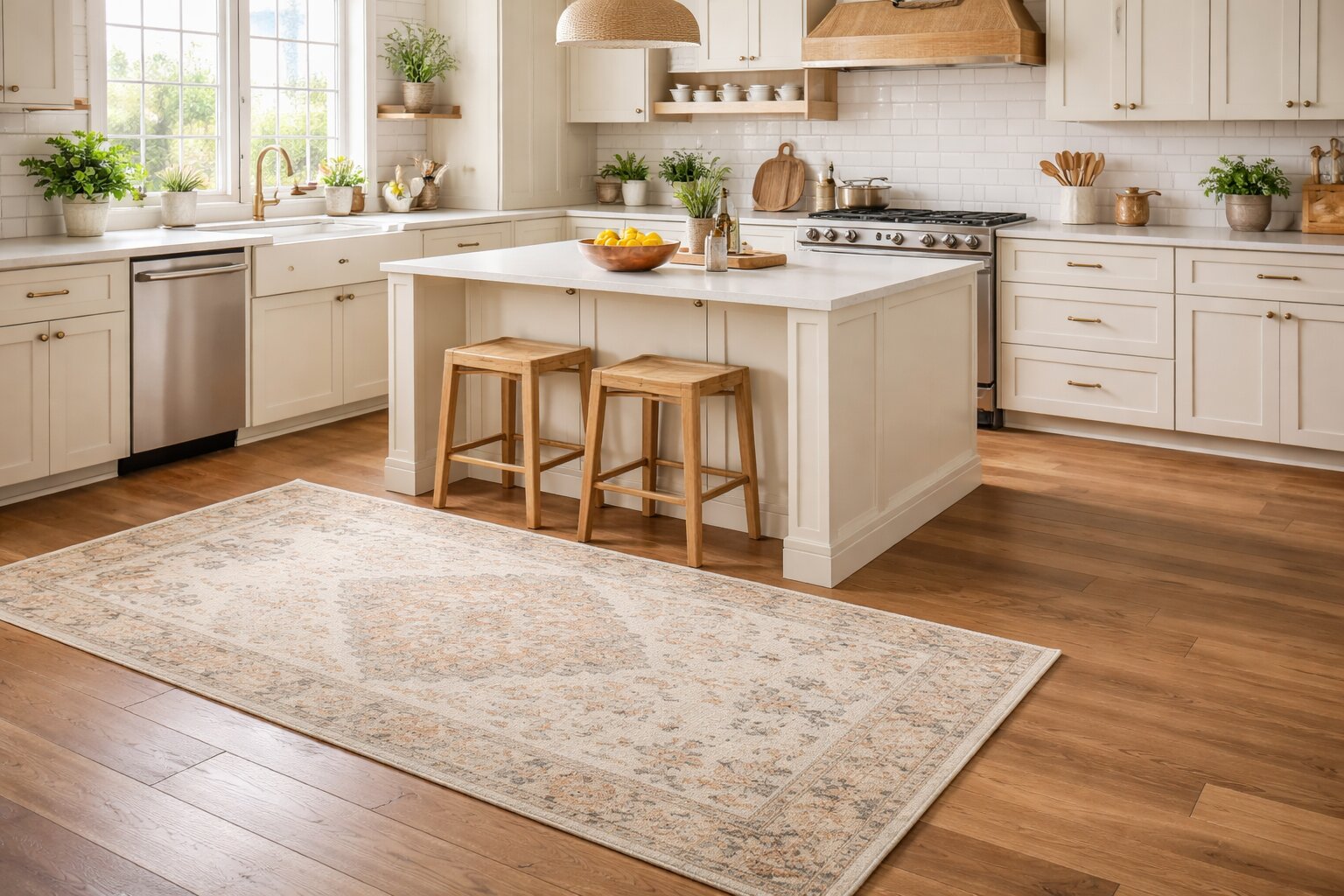
Farmhouse and transitional kitchens: Distressed patterns, medallion prints, and refined checks in warm cream, taupe, and terracotta. Subtle distressing hides dirt beautifully between washes. A great place to explore our [Farmhouse & Boho Kitchen Rug Styles] guide.
Modern and minimalist kitchens: Solid colors or simple geometric patterns in low-pile flatweave. One bold jewel-toned rug — an emerald green runner or a sapphire area rug — can be the single most impactful design move in an all-white kitchen.
Eclectic and maximalist kitchens: Vintage-inspired or Moroccan patterns, rich jewel tones, and layered textures. If your kitchen has personality, a rug with character can amplify it. See our [Vintage & Moroccan Kitchen Rugs: Adding Character] guide for what’s working in 2026.
Scandinavian and coastal kitchens: Stripe runners, neutral flatweaves, and natural fiber accents. Clean lines, pale tones, and minimal pattern.
Color: Our Practical Rules
For high-spill zones (sink, stove): Choose mid-tones or patterns. Light colors show every drip; very dark solids show every piece of lint. A medium-toned pattern — think distressed navy, warm terracotta, or a muted stripe — hides daily wear most gracefully.
For style statements: Jewel tones (emerald, sapphire, deep terracotta) are the biggest trend of 2026 and can completely transform an otherwise neutral kitchen. They work especially well as runners or sink mats in white or gray kitchens.
For small kitchens: Stick to light colors and simple patterns. Dark heavy-patterned rugs visually shrink already compact spaces.
🔗 Read more: [Kitchen Rug Color Trends 2026] — our full color guide with specific shade recommendations by kitchen style.
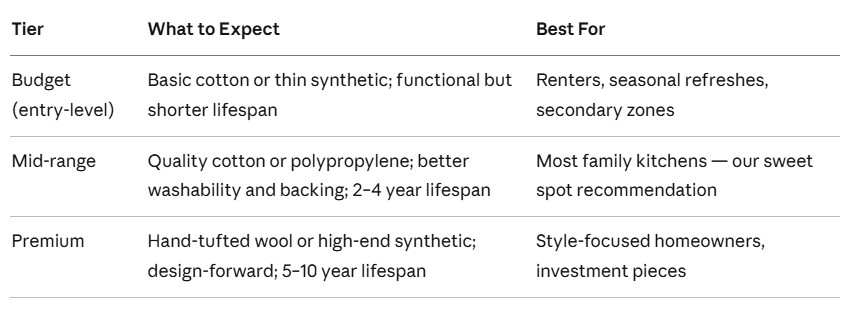
Our recommendation for most readers: The mid-range tier delivers the best combination of durability, washability, and style for everyday family use. We only recommend spending premium-tier prices when the rug will be placed away from high-splash zones and you’re treating it as a genuine design investment.
🔗 Read more: [Budget vs Premium Kitchen Rugs: When to Splurge or Save] — our honest breakdown of where the price difference actually matters.
Our Complete Kitchen Rug Buying Checklist
Before you click “add to cart,” run through our full checklist:
Size & Placement:
-
✅ Have I measured the exact zone (not just the room)?
-
✅ Have I left 4–6 inches of clearance from cabinet bases and island legs?
-
✅ Have I checked that the rug won’t block any door swings?
-
✅ Have I laid out painter’s tape to test the proportions?
Material & Performance:
-
✅ Is the material suited to the moisture level of this zone?
-
✅ Is it machine-washable in my home washer?
-
✅ Does it have quality non-slip backing — or do I need a rug pad?
-
✅ Is the pile height low enough to stay flat at the edges?
Style & Budget:
-
✅ Does the color and pattern work with my existing floors and cabinets?
-
✅ Is the color mid-toned or patterned enough to hide everyday spills?
-
✅ Am I paying for quality where it matters — or overspending on a trend?
Step 6: Set a Realistic Budget
Here’s our honest budget breakdown for kitchen rugs in 2026. Prices fluctuate on retail platforms, so we focus on tiers rather than specific figures.
Frequently Asked Questions
What size rug should I get for in front of the kitchen sink? We recommend 18–24 inches deep (front-to-back) and 24–36 inches wide. You want your entire standing stance covered, not just the tips of your toes. For a wide double sink, go wider — up to 48 inches if your space allows.
What is the best material for a kitchen rug? For most family kitchens, we recommend cotton (for softness and easy washing) or polypropylene (for superior stain resistance and durability). Wool is excellent for style and longevity but isn’t machine-washable. Natural fibers like jute are best reserved for dry zones away from the sink.
Do kitchen rugs need a non-slip pad? Yes — either built-in or separate. Any rug placed on a hard floor near a water source should have reliable grip. Don’t assume a rubber backing alone is sufficient; test it on your specific floor before trusting it fully.
How often should I wash a kitchen rug? We recommend a full machine wash every 2–4 weeks for the main kitchen rug, and a quick shake-out or vacuum weekly. If you cook daily or have pets, wash every 1–2 weeks.
Can I put a rug in front of my stove? Yes, with some precautions. Choose a low-pile, machine-washable rug and keep it back slightly from the stove’s edge — typically 12–18 inches minimum. Avoid high-pile or looped rugs near cooking zones where embers or grease could land.
🔗 Read more: [Kitchen Rug Cleaning & Care Tips] — our step-by-step maintenance guide for every material type.
Our Bottom Line
Choosing a kitchen rug well comes down to five honest questions: What size fits this space? What material can I actually clean? Will it grip the floor reliably? Does it suit my kitchen’s aesthetic? And is the price realistic for how long I want it to last?
Work through those five questions systematically — using this guide as your framework — and you’ll land on the right rug for your home. It’s not complicated once you have a clear process.
And if you want to skip the research entirely and go straight to our tested picks, our [Best Kitchen Rugs 2026: Our Top Picks] has our full curated shortlist organized by use case.
Happy decorating! 🏡
Explore the Full Housenique Kitchen Rug Series
-
🔗 [The Ultimate Guide to Kitchen Rugs for US Families] ← Start here
-
🔗 [Non-Slip Kitchen Rugs: Safety for Kids and Pets]
-
🔗 [Kitchen Rug Size & Placement Guide]
-
🔗 [Kitchen Rug Materials: Cotton, Jute, Wool or Synthetic?]
-
🔗 [Anti-Fatigue Kitchen Rugs vs Mats: Which Is More Comfortable?]
-
🔗 [Kitchen Runner Rugs: How to Use Runners to Define Space]
-
🔗 [Farmhouse & Boho Kitchen Rug Styles]
-
🔗 [Organic & Natural Fiber Kitchen Rugs: Sustainable Choices]
-
🔗 [Vintage & Moroccan Kitchen Rugs: Adding Character]
-
🔗 [Kitchen Rug Color Trends 2026]
-
🔗 [Budget vs Premium Kitchen Rugs: When to Splurge or Save]
-
🔗 [Eco-Friendly & Washable Rugs for Busy Families]
-
🔗 [Kitchen Rug Cleaning & Care Tips]
-
🔗 [Small Kitchen & Breakfast Nook Rug Ideas]
